Sunday, 13 September 2015


http://image.slidesharecdn.com/acrlinfolitstandardsppt-150330172730-conversion-gate01/95/acrls-new-information-literacy-standards-5-638.jpg?cb=1427736530


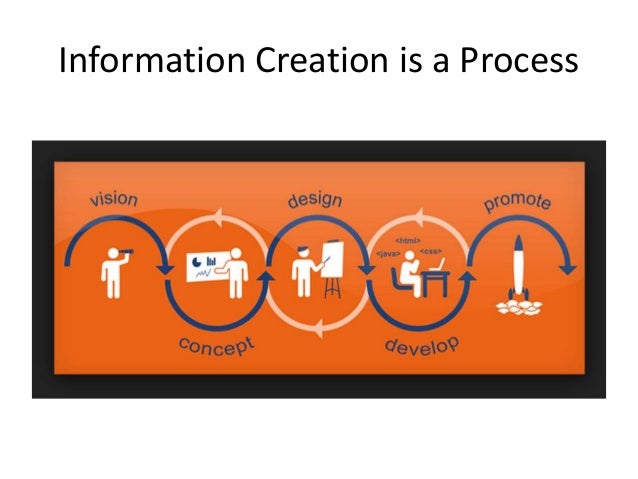
This Frame refers to the fact that the purpose, message and delivery of information are intentional acts of creation. The usefulness of information are determined by the process of creating that information as well as the final product. Information is published and distributed in a variety of formats. Each source of information have constraints and limitations. Information in its various formats may be useful in different ways and not all the formats have the same level of Authority. They can however contribute to scholarly conversations. Different formats are created differently and students need to understand the purpose and processes behind the creation of these formats as well as how and when to use it

Assignment

 
Use your research topic and do a thorough search for information on the topic. Gather as many formats as possible. Select the formats that you feel would meet your research expectations. Explain why you chose those formats. Secondly, transform at least two of those formats into another source type.
Journal Articles

Walker, M. 2005, "Rainbow nation or new racism? Theorizing race and identity formation in South African higher education", Race, Ethnicity & Education, vol. 8, no. 2, pp. 129-146.

MEKOA, I. (2011). Discourses and politics of racism in higher education in South Africa. Africa Insight. 40, 104-120.

Audio-visual Material

https://www.youtube.com/watch?v=sF3rTBQTQk4&feature=youtu.be
https://www.youtube.com/watch?v=r_a-q36mFzM

Printed Books
Johnson, J.D.2009.Knowledge in the Blood: Confronting Race and the Apartheid Past. Juta and Company Ltd: South Africa

Ahmed, S. 2012.On Being Included: Racism and Diversity in Institutional Life. Duke University Press: North Carolina

Newspaper articles

http://www.bdlive.co.za/national/education/2015/08/25/state-has-plan-to-fight-racism-at-universities


 http://www.thenewage.co.za/169133-1007-53Stellenbosch_University_VC_admits_to_racism_at_the_institution

The reasons I chose these particular format is that the journal are all peer reviewed, The audio-visual material gives us a first person narrative of their life under apartheid on a university campus. The books give background information to the problem and the newspaper articles gives us an up to date view and information concerning the problem.

 Topic

An investigation on racism between first year UWC students.

  1. Journal Article.

http:roxy.uwc.ac.za/webx/access/electronic_journals/afrins/afrins_v40_n4_a9.pdf


MEKOA, I. (2011). Discourses and politics of racism in higher education in South Africa. Africa Insight. 40, 104-120.

Transformed to:
 
Powerpoint Presentation   


 2.Youtube Video

Luister

Transformed to:
 
 
Article
Luister is a documentary about the lives of students of colour who attend Stellenbosch University, a South African institution of higher learning. In a series of interviews, students recount instances of racial prejudice that they continue to experience in the town of Stellenbosch, and the enormous challenges that they face due to the use of Afrikaans as a language of teaching at the university. Luister is a film about Afrikaans as a language and a culture. It is a film about the continuing racism that exists within a divided society. It is a film about a group of students whose stories have been ignored. Luister is the Afrikaans word for Listen


Monday, 7 September 2015

Workshops


http://karmic2015.com/wp-content/uploads/2015/02/banner.jpg

What is a workshop?

According to SIGCSE 2013 "Workshops provide an in-depth review of (or introduction to) a topic of interest to the community, typically provide participants with materials and/or ideas that are immediately useful in the classroom, and ideally devote significant time to hands-on activities by the attendees." http://www.sigcse.org/sigcse2013/authors/authworkshops.php
So in my understanding workshops provide platforms in which ideas or concepts can be relayed to relevant communities which can provide the communities with relevant tools or ideas that can be useful to them.

Importance of workshops?

Workshops help organisations to get up to date information. They create learning communities and allow for networking within an organisation or discipline. Experts on hand will answer questions employees might have. Workshops also allows for vital information to reach a group of people simultaneously.

Why I would give a workshop ?

I would give a workshop to teach educators how to use the Frame in their teaching practices.

When would I conduct a workshop?

I would conduct a workshop when it would be most convenient for my target audience to attend taking into account work timetables as well as social agendas. If target audience are mothers for example I would schedule it at a time their children would be at school. If workshop is about work and work related I would schedule it in work hours. The audience will determine the suitability of a timeframe. For students and learners I would conduct a workshop when it is vacation time or on weekends so that it does not clash with their class timetables.


How do you conduct a workshop?

Steps for conducting a workshop according to the Faculty Development Office, Faculty of Medicine, McGill University available: http://www.mcgill.ca/medicinefacdev/files/medicinefacdev/DesigningWorkshopsWorkbook.pdf

1- Defining a Topic & Identifying the Target Audience
2- Conducting a Needs Assessment
3- Defining Workshop Goals and Objectives
4- Deciding on Time Frame and Number of Participants
5- Defining and Designing Workshop Content
6- Matching Teaching Methods to Content and Objectives
7- Choosing Teaching and Learning Resources
8- Designing a Workshop Program/Agenda
9- Designing the Workshop Evaluation
10- Fine-Tuning the Workshop Plan
11- Recruiting and Preparing Workshop Faculty
12- Determining Locale and Workshop Budget
13- Deciding on Marketing Strategies
14- Finalizing Administrative Details
15- Conducting the Workshop

On a more practical level:
  • Prepare Your Talk: rehearse your topic, prepare hand outs and schedule your time including Q&A time
  • Prepare Yourself: Be comfortable, bring a water bottle
  • Control the room: make eye contact, relax, encourage discussion
  • Make yourself available after the workshop for a few minutes to engage with audience
With workshops for students and learners the atmosphere have to be relaxed and upbeat so as not to bore them. Young people are more technologically inclined so I will have to make sure that computer access is available for practical searches. With information literacy showing them how to do searches is more effective than just telling them how to. Frequent breaks will have to be scheduled for. Time will have to be flexible so that they do not feel that they are rushed when struggling to comprehend concepts. I will have to give the workshop in the language they understand and respond to.


Authority is constructed and contextual

The leading authority on a subject is not necessarily an expert on said subject and authority may be the result of exposure, popularity or prestige. The context within which information is needed determines the level of authority needed. Certain voices are elevated within a discipline. Even in an academic setting certain "expert's " work are more favoured during lectures and the assigning of coursework and text books.
Students need to learn that there are different types of authorities and to use tools of indicators to establish credibility of authors. They need to learn that information are produced using various resources and formats.
 

 https://i2.wp.com/farm6.staticflickr.com/5004/5255426412_b46f9b3dc7.jpg

Teaching Scenario:

Topic: Life under apartheid in Cape Town during 1960-1980: A "coloured" perspective.

Materials Needed:

  1. Computers with access to the internet
  2.  List of authority indicators .See http://help.library.ubc.ca/evaluating-and-citing-sources/evaluating-information-sources/
  3. Voice recorder to record interview e.g. cellular phone voice recorder

Activities:

  1. Find books and other 3 other media sources on the topic: e.g. journal articles, newspaper articles, podcasts, etc.
  2.  Describe the tools used to establish the authority of the authors .
  3. Do an interview with someone who was incarcerated for political reasons in Cape Town during that time. Compare the information gleaned from the interview with that collected via the other sources.

Learning Outcomes/ Knowledge practices:
  

  1.  Recognise that authoritative content may be packaged formally or informally and may include audio, visual an non-print sources
  2.  Use markers of authority to determine the credibility of sources
  3. Students should be able to define different types of authority such as subject expertise (Scholarship), society position (public office or title), or special experience (participating in an historic event)


Saturday, 22 August 2015


Research as Inquiry


This Frame deals with using research to fill gaps in knowledge. To extend knowledge questions have to be asked and from those more complex questions arises. This process usually involve debates from various perspectives but it all helps to extend knowledge in that specific field. Students need to realise that the process is not straight forward and can become very frustrating. Data collection requires students to communicate and liaise with the community role players and the recognition of how issues affect the community.  Research methodologies need be employed that will suit the issues being researched.

Knowledge Practices


Students will learn how to formulate and refine research questions based on gaps in information, learn how to determine appropriate scope of investigation, breaking down complex questions and use various research methodologies. They will learn to monitor, organise and synthesize information gathered and then draw reasonable conclusions based on analysis.

Disposition


Students will recognise their own limitations and ask for help when needed. They will seek alternate views and compare it with mainstream views while following ethical and legal guidelines in using the information gathered.


This Frame seem very simple but the process is very important in doing research effectively and accurately. It teaches us that we are all just a link in the world of information gathering. Any information out there both supporting and contradicting our views influence our own knowledge.


Teaching Scenario


Research Question


Investigating  racism between first year students at UWC.


Learning Outcomes


·         Students should be able to formulate proper research questions

·         Students should be able to understand how research issues affect the greater community

·         Aquiring the ablility to handle data gathering on a sensitive topic from a diverse group of      people.

Activities


·         Indicate an additional question arising from the data gathered that you could further investigate as an independent topic.(Disposition :consider research as an open-ended exploration and engagement with information). (Knowledge Practice: formulate questions for research based on information gaps or reexamination of existing, possibly conflicting, information;
·         Design two questionnaires/surveys.: One for students and one for academic staff. Analyse and compare data gathered from the two groups. (Disposition: Seek multiple perspectives during information gathering)

·         Read the two articles provided on racism at other universities. Based on your research   analysis what additional steps could the universities have taken to address and eradicate the problem. ( Knowledge Practice: Use research appropriately to make decisions and take action)

Sunday, 9 August 2015

Scholarship is a conversation

The Framework definition: it is communities of scholars in a sustained discourse, where everyone brings some new insight into the scholarly conversation
No idea stands alone and is dependent on what preceded it. Each idea is just one voice of many and there is no single answer as every document may be created as a reaction to other ideas. There are various tools through which to converse as not all participants interact through written texts.
This week we have looked as "Scholarship is a conversation" more closely and I have to say that I understand it a little bit better. It's not just an abstract term hanging in the air. My colleagues seem to grasp the concepts so much easier than I am but it could be that I am very critical and first have to work out the significance of something new in my own mind. I have to say that the support and help I receive from classmates is overwhelming. So this week we have to formulate an assignment for scholars using "Scholarship is a conversation". We have to find a topic, draft 3 learning outcomes ,design 3 activities and show how each activity relates to a "knowledge practice" or "disposition"

So here goes:

Assignment:

Write an investigative report on the advantages and disadvantages of co-ed vs single sex schools. Your report should include:
  • Issues of safety (physical, moral, sexual etc.)
  • Academic performances of the different genders within the schools.
  • Social issues: socialising with the opposite sex in an academic setting. Advantages and Disadvantages.
  • Motivation of your thoughts on the topic.

Learning outcomes

  • Engage in scholarly conversation
  • seek out conversations that are taking place in their area of research.
  • Critically evaluate contributions made by others.

Activities

  • Find articles on the topic. You should critically analyse the content. Your report should include literature supporting both sides of the argument; pro- and anti co-ed schools. Articulate conflicting perspectives as expressed in various sources (Scholarship as a Conversation
  • Your report should include blog posts, journal articles, newspaper articles and social media posts.(Disposition: recognize that scholarly conversations take place in a variety of venues)
  • Comment on at least two blogs relating to the topic.(Disposition:see themselves as contributors to scholarship rather than only consumers of it)


http://www.washingtonparent.com/articles/1302/image/coed-vs-single-sex-schools-300x300.png
Thursday, 30 July 2015

Threshold Concepts and the ACRL framework for Information Literacy for Higher Education.

Threshold Concepts

First of all we need to understand what the term "threshold concepts" mean. According to Vocabulary.com "A threshold takes you from one place into another, and when you're about to start something new, you're also on a threshold." (http://www.vocabulary.com/dictionary/threshold)
Many liken threshold concepts to passing through a portal that opens up a previously inaccessible way of thinking. Land & Meyer terms it as the core ideas and processes that relate to a specific discipline.

Criteria for Threshold Concepts:
  • It is transformative: it changes the way you see things. New thinking becomes part of the self. Students start to think like a professional instead of student.
  • It is integrative: it brings together different concepts/ disciplines. It exposes hidden inter relatedness
  • It is irreversible: Once understood it cannot be unlearned
  • It is bounded: It defines academic territories.
  • It is troublesome: It is usually difficult to unlearn old methods of doing things and the reversal of old methods can be uncomfortable. Concepts in themselves are difficult to understand.

Framework for Information Literacy for Higher Education

There are six (6) frames of Information Literacy for Higher Education:
  1. Scholarship is a conversation: There are no easy or single answer in scholarly research, as it is ongoing and discoveries give rise to new ideas and new discoveries. Students are given the opportunity to become conversant in a discipline. It is a practice where ideas are discussed, debated and formulated.
  2. Research as Inquiry: students have to rethink, rework, test and explore concepts of their discipline. They need to be taught how to identify unresolved issues and frame questions. This process includes various research methodologies
  3. Authority of text is contextual and constructed: It is dependent on the origin, information need and context within which information will be used. The information need help determine the level of authority needed. It is acknowledged that certain views will be elevated (favouring certain authors). All sources are not equal.
  4. Information creation as a process: Information is created to convey a message  via various formats.
  5. Searching as exploration: Search strategies are not straightforward and involves inquiry, discovery. Discovery of one source may lead to another. Students should be able to match informational need and search strategies with the appropriate search tool.
  6. Information has value: Students should understand the legal and ethical obligation to cite work of others and to give proper acknowledgements when using ideas of others. Students should be able to understand the differences between copyright, open access and public domain.
http://www.slideshare.net/fullscreen/estellep/acrl-information-literacy-framework-staff-poster-presentation/1

I am still a little bit in the dark as to how we are going to implement this information in our practices as librarians and what impact it will have, For now it is still abstract concepts based on information we already have. It is nevertheless very interesting to learn and I can't wait to see where this journey will take us. Hopefully I will soon cross that threshold, and see the light


Saturday, 25 July 2015

Information Literacy... Continues

This past week I have been fortunate enough to attend a Fieldwork practical at UWC library. One of the aspects we were shown was Information Literacy and how to do searches and find various types of information. I would recommend anyone to go to information sessions at the library as I was amazed at all the possible avenues open to us as students to find accurate, current and relevant information. I just regret not having done this last year or when I was a first time student some years ago. The information I received would have made my academic life so much easier. The saying "Work smarter not harder" is so true. It also made me realise how much I still need to learn regarding IL.